
In the annals of sporting history, few names resonate with the global magnitude and universal recognition of Cristiano Ronaldo dos Santos Aveiro. He transcends the boundaries of mere athleticism he is a modern gladiator, an international brand, a cultural phenomenon, and an extraordinary case study in the limitless possibilities of human will and dedication. While others may possess more innate, fluid natural magic, Ronaldo stands as the ultimate testament to what can be achieved through the relentless, obsessive pursuit of perfection across more than two decades of elite competition.
Cristiano Ronaldo Biography: Age, Goals & Net Worth (2026)
Born on February 5, 1985, in Funchal, Madeira, Portugal, the man affectionately nicknamed CR7 continues defying age and conventional athletic limitations well into his forties. At 41 years old in 2026, he has shattered virtually every meaningful record in professional football, accumulating over 960 official senior career goals the most by any player in recorded history across more than 1,300 professional appearances, representing the highest total for any outfield player in the sport’s existence.
Currently serving as captain of both Al-Nassr in the Saudi Pro League and Portugal’s national team, Ronaldo’s trophy cabinet overflows with five Ballon d’Or awards (2008, 2013, 2014, 2016, 2017), four UEFA Champions League titles, seven domestic league championships across three different countries, and the distinction of leading Portugal to their first-ever major international trophy at the UEFA European Championship in 2016, followed by the inaugural UEFA Nations League in 2019.
His remarkable journey from an impoverished upbringing on a small Atlantic island to global billionaire status with a net worth reaching $1.4 billion in 2026, making him football’s first billionaire epitomizes relentless ambition, physical perfectionism, and extraordinary mental fortitude. The legendary rivalry with Lionel Messi has defined an entire era of football, but Ronaldo’s legacy transcends statistics and trophies: he represents a brand, a philanthropist, and a devoted family man whose influence spans continents and inspires billions worldwide.
Early Life and Family Background
Ronaldo’s entry into the world was marked by circumstances that could hardly have predicted his eventual greatness. Born into significant hardship in Santo António, Funchal, he arrived as the youngest of four children to Maria Dolores dos Santos Aveiro, a part-time cook and cleaner, and José Dinis Aveiro, a municipal gardener who also served as kit man for local club Andorinha. His father, who had Cape Verdean roots, struggled with severe alcoholism a trauma that profoundly shaped young Cristiano and led him to abstain completely from alcohol throughout his adult life.

The family’s poverty was stark and unrelenting. Ronaldo shared a cramped, tin-roofed home with his siblings older brother Hugo, and sisters Elma and Liliana Cátia (known as Kátia). His name, “Ronaldo,” was chosen by his father in honor of U.S. President Ronald Reagan, whom José Dinis admired. Remarkably, Maria Dolores has publicly acknowledged that she considered terminating the pregnancy due to the family’s desperate financial circumstances, but was denied by the doctor a decision that preserved the life of a future legend.
From earliest childhood, football became Cristiano’s escape from poverty and family turmoil. However, his dreams nearly ended prematurely when, at just eight years old, he was diagnosed with tachycardia a racing heart condition that caused alarming palpitations during physical exertion. Laser surgery successfully addressed the problem, and he was back training within days, foreshadowing the superhuman recovery abilities that would characterize his career.
Tragedy struck the family in 2005 when José Dinis died of liver failure at just 52 years old. This devastating loss deeply affected Ronaldo, who has spoken emotionally about his father never witnessing the full extent of his success. The pain of this loss became fuel for his relentless drive to achieve greatness. Meanwhile, Madeira’s streets served as his training ground, honing the dribbling skills that would later mesmerize the world’s greatest stadiums.
Youth Career and Breakthrough at Sporting CP
Ronaldo’s extraordinary talent manifested unmistakably from his earliest years. At seven years old, he joined Andorinha (1992-1995), where his father worked as kit man, immediately demonstrating prolific scoring ability that set him apart from peers. He progressed to CD Nacional (1995-1997) before Sporting CP identified his exceptional potential and signed him at just twelve years old for approximately €1,500 following dazzling trial performances.
The move to Lisbon demanded enormous sacrifice from the young Madeiran. Separated from his family at a tender age, he endured persistent homesickness, crying himself to sleep regularly while adjusting to life in the competitive academy environment. His thick regional accent made him a target for bullying from mainland Portuguese teammates. His fiery temperament nearly derailed his career when he was almost expelled for throwing a chair at a teacher who had disrespected him.
Yet on the pitch, young Ronaldo was simply undeniable. He achieved the remarkable distinction of becoming the only player in Sporting CP history to represent the U-16, U-17, U-18, B-team, and first team all within a single season. His senior debut arrived on August 14, 2002, against Moreirense in a 3-0 victory, announcing his arrival to professional football.
The pivotal moment that would transform his career entirely occurred on August 6, 2003. Sporting CP hosted Manchester United for the inauguration of the Estádio José Alvalade. The eighteen-year-old Ronaldo, sporting distinctive silver boots, absolutely tormented United’s defense throughout the match. Defender John O’Shea, tasked with marking him, was reportedly left needing an oxygen mask at halftime after being repeatedly embarrassed.
On the flight back to England, United players including Rio Ferdinand and Roy Keane urgently implored manager Sir Alex Ferguson to sign the prodigious teenager. Ferguson, who had already been tracking Ronaldo, refused to leave the stadium until negotiations were completed. The deal was finalized at £12.24 million a record fee for a teenager in English football at that time.
Manchester United: Rise to Stardom (2003-2009)
When Ronaldo arrived at Old Trafford, he modestly requested jersey number 28. Ferguson refused, instead bestowing upon him the iconic Number 7 previously worn by legends including George Best, Eric Cantona, and David Beckham. It represented both tremendous honor and immense pressure for the teenage newcomer.
His debut came on August 16, 2003, as a substitute in a 4-0 victory against Bolton Wanderers, immediately demonstrating the flair that had captivated the United squad. However, early assessments were mixed. Critics labeled him a “show pony” a player with excessive step-overs and insufficient end product. Physically, he appeared frail and was frequently bullied by robust Premier League defenders unimpressed by fancy footwork.
Under Ferguson’s fatherly guidance and technical coach René Meulensteen’s specialized drills, Ronaldo underwent a remarkable transformation. He committed himself to the gymnasium, bulking up considerably to handle the physicality of English football while maintaining his explosive speed and agility. Teammates nicknamed him “Little Bee” for his buzzing, energetic runs that tormented defenders.
The 2006 World Cup created a temporary crisis when Ronaldo’s involvement in Wayne Rooney’s red card and the infamous “wink” at the Portugal bench made him public enemy number one throughout England. Rather than crumbling under the hostility, Ronaldo channeled the hatred into motivational fuel, returning to Manchester United as a transformed, more ruthless competitor.
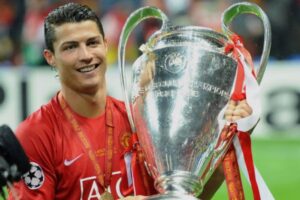
The 2007-2008 season stands among the greatest individual campaigns in Premier League history. Ronaldo scored 42 goals across all competitions, including 31 in the Premier League alone, powering United to a historic Premier League and Champions League double. His towering header in the UCL final against Chelsea epitomized his aerial dominance. At just 23 years old, he claimed his first Ballon d’Or and FIFA World Player of the Year award.
By 2009, having won three consecutive Premier League titles (2006-2009), one Champions League, and one FIFA Club World Cup, Ronaldo had conquered English football completely. However, the allure of Real Madrid the “White House” of global football proved irresistible.
Real Madrid: The Galactic Era (2009-2018)
In summer 2009, Real Madrid shattered the world transfer record, paying €94 million to secure Ronaldo’s services. His presentation at the Santiago Bernabéu attracted 80,000 adoring fans a record for any player unveiling in football history.
This era defined modern football through the legendary rivalry between Ronaldo and Lionel Messi. For nine years, these two extraordinary talents pushed each other to unprecedented heights, splitting Ballon d’Or awards and rewriting record books. While Messi was perceived as the natural genius blessed with divine gifts, Ronaldo represented the machine the inevitable result of total dedication and relentless self-improvement.
At Madrid, Ronaldo evolved tactically once again. As age gradually diminished some raw pace, he transitioned from pure winger to inverted forward, eventually becoming a lethal penalty-box predator whose anticipation and aerial ability proved unrivaled. The 2011-12 season saw him score 60 goals, powering Madrid to a 100-point La Liga record.
His achievements in the Spanish capital remain staggering. He became Real Madrid’s all-time top scorer 450 goals in 438 appearances, maintaining a ratio exceeding one goal per game. He led Madrid to “La Décima” (the tenth Champions League title) in 2014. Under Zinedine Zidane’s management, he spearheaded three consecutive Champions League triumphs (2016, 2017, 2018). Four additional Ballon d’Or awards confirmed his sustained excellence.
His bicycle kick against Juventus in the 2018 Champions League quarter-final is widely regarded among the greatest goals ever scored. The Juventus supporters stood and applauded their tormentor a gesture that deeply moved Ronaldo and foreshadowed his next destination.
Later Career: Juventus, Manchester United Return, and Al-Nassr
Seeking new challenges at 33, Ronaldo moved to Juventus for €100 million the highest fee ever paid for a player over 30. Critics questioned whether he could adapt to Serie A’s defensive rigidity. He responded by winning two consecutive league titles and becoming the fastest player to reach 100 goals for the club, while also becoming the first player in history to top goal-scoring charts in England, Spain, and Italy.
A romantic 2021 return to Manchester United, facilitated by a phone call from Sir Alex Ferguson, initially produced fairytale moments including a two-goal debut against Newcastle. However, friction with managers and the club’s declining standards led to an explosive November 2022 interview criticizing ownership and management, resulting in contract termination.

In January 2023, Ronaldo shocked football by joining Saudi Arabian club Al-Nassr in a deal reportedly worth €200 million annually. Rather than a “retirement home,” he transformed the Saudi Pro League’s global profile, triggering an influx of world-class talent. By 2026, he had accumulated 121 goals in 136 matches, including 50 in his debut SPL season.
International Career and Personal Life
Ronaldo’s international career spans over two decades, establishing him as Portugal’s most-capped player (212+ appearances) and international football’s all-time leading scorer (130+ goals). His crowning achievement came at Euro 2016 though injured early in the final against France, he inspired teammates from the sidelines to secure Portugal’s first major trophy.
His partnership with Georgina Rodríguez has produced a blended family of five children: Cristiano Jr. (born 2010, now a footballer), twins Eva Maria and Mateo (2017), Alana Martina (2017), and Bella Esmeralda (2022). Tragedy touched the family when twin son Ángel died during childbirth a loss that humanized the “machine” and prompted worldwide solidarity.
Legacy and Conclusion
Cristiano Ronaldo’s extraordinary odyssey from Madeira’s impoverished streets to global billionaire status transcends sport entirely. His work ethic, encapsulated in his philosophy that “talent without work is nothing,” combined with continuous reinvention and record-breaking performances, cements his status among the greatest athletes in human history. As he approaches 1,000 career goals, Ronaldo inspires billions worldwide: living proof that dreams demand sacrifice, and greatness can be built through dedication, discipline, and an insatiable refusal to accept limitations.


